
What is C.Scale?
C.Scale is a whole life carbon tool delivering carbon clarity from concept to construction. Starting with simple inputs at the earliest project stages, C.Scale’s modeling resolution increases alongside your design—connecting early massing studies to detailed assembly modeling and product selection, and maintaining context for carbon decisions throughout the project lifecycle. C.Scale uses a model that combines regionally-specific background data, forward-looking projections, peer-reviewed findings, and industry-leading ML models to assess the relative impact of a variety of carbon reduction measures on a project’s embodied, operational, and landscape carbon footprints.
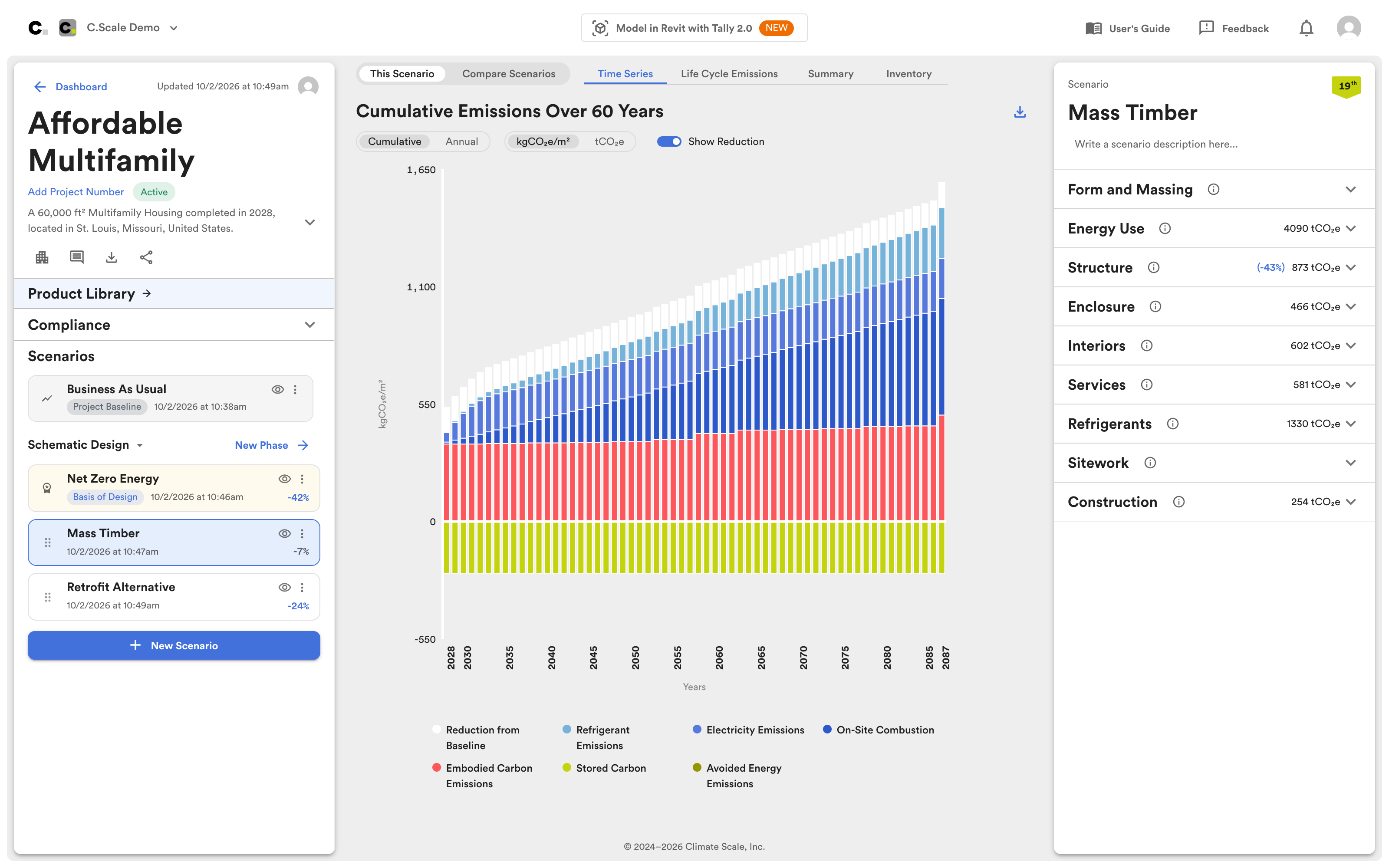
Aggressive time-based targets have been set for the built environment as part of a society-wide strategy to combat the climate crisis. To meet these targets, quantification of the project’s whole life carbon footprint cannot wait until later project stages, at which point many impactful decisions have already been made. C.Scale is designed as the first step in an iterative low-carbon design process, setting out strategies and project-level targets that can be refined throughout the project lifecycle.
C.Scale is useful to project teams:
in setting a whole life carbon budget for a project.
to identify carbon hot spots early and evaluate the most impactful reduction strategies, when the potential for change is highest.
to increase modeling resolution as design progresses—from massing-level estimates through detailed structural, enclosure, and interior modeling.
to select specific products using the EPD library, adding specificity and supporting committed design decisions.
to compare whole life carbon emissions across projects in your entire portfolio. [Organization feature]
C.Scale is designed to work like a shoebox model at the start of a project—simple inputs, fast iteration, and a clear picture of where emissions are coming from. As the design progresses, that picture fills in: modeling resolution increases for structure, enclosure, and interiors, and specific products can be selected from the EPD library. The goal is to identify hot spots early, model in detail where it matters most, and ultimately select products that commit the project to its carbon targets—all within a single, continuous workflow that preserves context from the first sketch to the last specification.

C.Scale is not a replacement for ISO-compliant LCA.
C.Scale is designed to accurately represent the overall effects of decarbonization strategies across the full arc of design, not to perform ISO-compliant whole building LCA. C.Scale can help your team compare a net zero energy retrofit with mass timber new construction, for instance, but is not designed to capture differences in, say, efficiency gains from changing structural bay sizes or specifying one brand of heat pump versus another.
C.Scale is not a fortune teller.
If we could predict the future with 100% accuracy, we'd be in another line of work. C.Scale contains estimates of future emissions, but the future is inherently uncertain. In 2021, for instance, the last version of our data models did not predict the passage of the IRA or the continued operation of California's Diablo Canyon Nuclear Power Plant—two events which have since come to pass and have significantly affected our estimates of electricity-related emissions from buildings. As a corollary, we are not in the business of predicting which low-carbon concrete technology will achieve the greatest market share, which timber supply chain will be most disrupted by climate change, and so on. To the extent that trusted data sources make these predictions, we follow their lead. Documentation of these data sources in the documentation for the underlying C.Scale data model.
Last updated
Was this helpful?

