# Set Target Scenario

After [comparing scenarios](/users-guide/compare-scenarios.md), you can choose the one that best suits your desired emissions scenario and set it as your "Target".

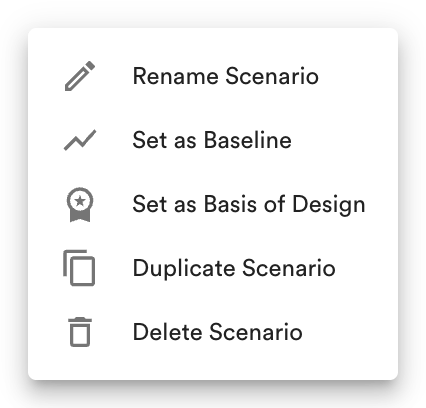
Set a scenario as your target by clicking the **3-dot menu** to the right of the scenario name in the left-hand panel.

<div align="left"><figure><img src="/files/bmSou9cB4FCo2Tkuf7mu" alt="" width="344"><figcaption><p>3-dot menu to the right of the scenario name.</p></figcaption></figure></div>

Within the menu, click **Set as Target**.

<div align="left"><figure><img src="/files/hKTdOf3OYWwLPtOj6ZV2" alt="" width="149"><figcaption><p>Set Target scenario</p></figcaption></figure></div>

The **Target scenario** also becomes your reference scenario when [comparing different projects within your portfolio](/users-guide/benefits-of-an-organization-account/create-a-portfolio.md) and for [AIA Ddx Reporting](/users-guide/benefits-of-an-organization-account/aia-ddx-reporting.md).


---

# Agent Instructions: Querying This Documentation

If you need additional information that is not directly available in this page, you can query the documentation dynamically by asking a question.

Perform an HTTP GET request on the current page URL with the `ask` query parameter:

```
GET https://docs.cscale.io/users-guide/compare-scenarios/set-target-scenario.md?ask=<question>
```

The question should be specific, self-contained, and written in natural language.
The response will contain a direct answer to the question and relevant excerpts and sources from the documentation.

Use this mechanism when the answer is not explicitly present in the current page, you need clarification or additional context, or you want to retrieve related documentation sections.